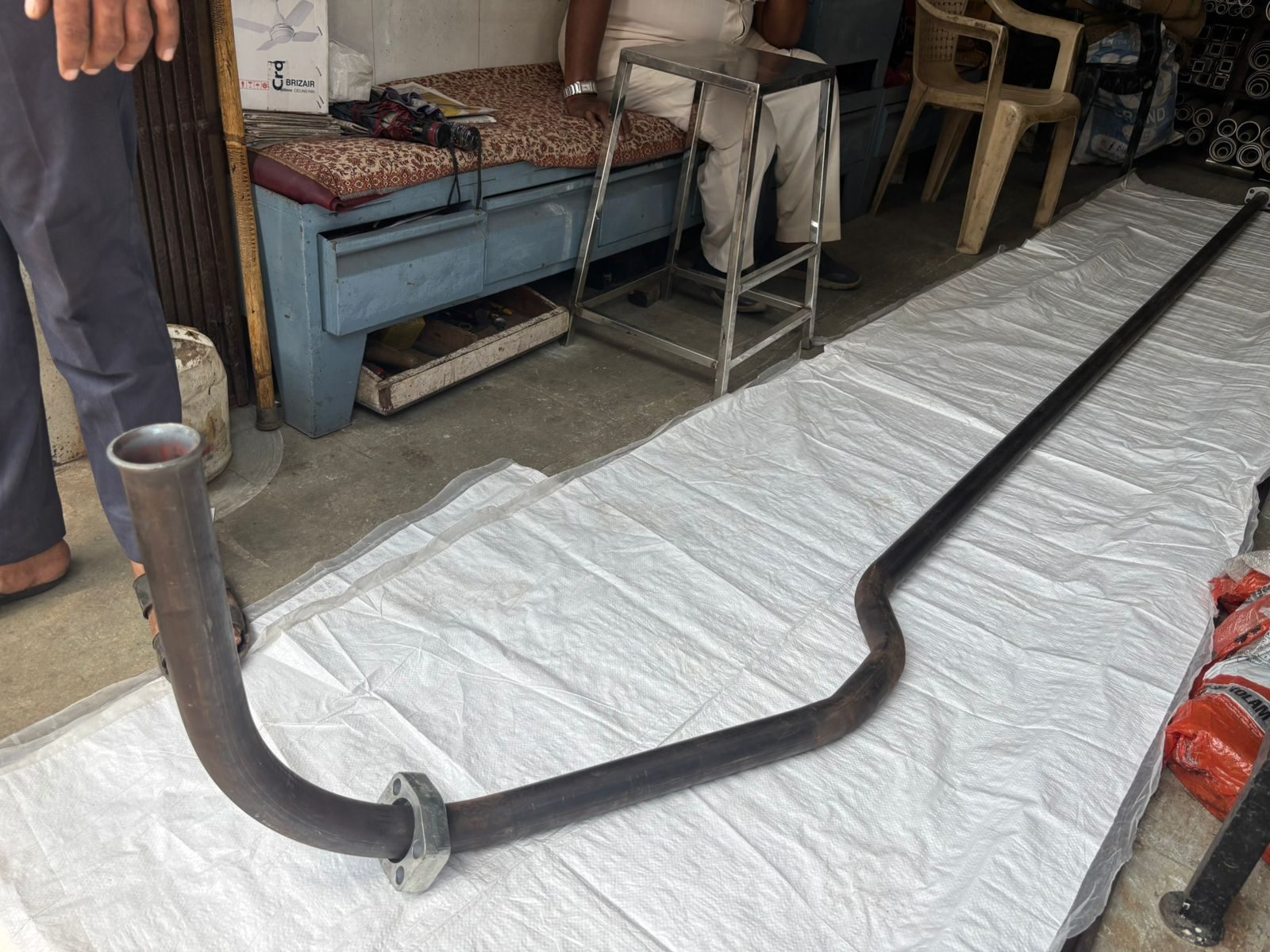
Seamless Pipe
No longitudinal weld. Preferred where the service is cyclic, high pressure or sour.
| Types | Seamless · ERW · Welded · Fabricated |
|---|---|
| Grades | Stainless 304/304L, 316/316L, 321, 347, 310S, 904L, 17-4 PH · Carbon API 5L, ASTM A106, A53, A333 · Duplex & Super Duplex S31803, S32205, S32750, S32760 · Nickel Alloy Inconel, Monel, Hastelloy, Incoloy · Aluminium 6061, 6063, 6082, 3004 · Special Alloy Titanium, Zirconium, Tantalum · Brass & Copper Cu-DHP, Cu-ETP, Admiralty, Naval, Cartridge |
| Sizes / NPS Range | NPS 1/2" to 24" standard · larger and custom sizes on enquiry |
| Schedules / Thickness | Sch. 5S to XXS · Sch. 5S, 10S, 40S, 80S (B36.19M) · Sch. 40, 80, 160, XXS (B36.10M) |
| Standards | ASTM · ASME · API · ANSI · DIN · EN · JIS · ANSI B36.10 / B36.19 |
| Ends | Plain end · Bevelled end · Threaded · Custom to drawing |
| Finish | Mill finish · Pickled & passivated · Polished · Mirror finish |
| Certification | Material Test Certificate (MTC) with every consignment · NACE MR0175 / ISO 15156 on request |
No longitudinal weld. Preferred where the service is cyclic, high pressure or sour.
Formed from strip and welded along the seam. Tighter diameter tolerance, more economical in larger runs.
Close-tolerance tube in stainless, cupro-nickel, titanium and nickel alloy for tube bundles.
Small-bore seamless tube, bright annealed, for impulse and hydraulic lines.
A pipe is defined by four things: the grade, the outside diameter, the wall thickness and the manufacturing route. Get any one of them wrong and the material is useless to you, however good the mill was.
Outside diameter is fixed by NPS. This surprises people new to piping: a 4" pipe has an outside diameter of 114.3 mm whether it is Sch 10S or Sch 160. Increasing the schedule thickens the wall inwards and reduces the bore. That is what makes the schedule system work — fittings, flanges and supports built for a given NPS fit any schedule of that size.
Wall thickness comes from the schedule. Carbon and alloy pipe follows ASME B36.10M (Sch 40, 80, 160, XXS). Stainless follows ASME B36.19M, whose S schedules — 5S, 10S, 40S, 80S — exist because stainless usually needs no corrosion allowance and can therefore be run thinner for the same duty. Note that 40S and Sch 40 are identical up to NPS 10 and diverge above it, and 80S and Sch 80 diverge above NPS 8. If a drawing says only “Sch 40” on a stainless line above 10", ask which standard is meant before you order.
Grade selection follows the service, not the budget. In rough order of increasing capability:
If you are choosing between two grades on cost, calculate on installed cost and expected life rather than on price per metre. A duplex line that runs at a reduced wall thickness is frequently cheaper installed than the 316L line it replaces.
Seamless pipe has no longitudinal weld and is the usual choice for highly cyclic service, sour service, and wherever the specification simply forbids a seam. Welded pipe — ERW, HFW or EFW — is formed from strip and welded along the seam, giving tighter dimensional tolerance, better surface finish and a lower price, and it reaches thin walls that seamless cannot practically achieve. In a properly made stainless seam no filler is added, so the weld is the same alloy as the pipe. Both routes are supplied under ASTM A312; the larger fusion-welded sizes fall under ASTM A358, where the class number tells you whether the weld was radiographed.
Send the grade and standard, the NPS and schedule (or the OD and wall in millimetres), the length and quantity, the end preparation, and the certification level. If the service is sour, add NACE MR0175 / ISO 15156. If it is hygienic, tell us the required internal finish and whether the bore must be ID scarfed. If it falls under Indian boiler regulations, say IBR at enquiry stage — retro-fitting IBR certification to material already made is not possible.
Request a quotation
Send the grade, size, schedule and quantity and we will come back with availability, lead time and price. No account, no sign-up.