Weld Neck
Long tapered hub butt welded to the pipe. The strongest joint and the standard choice for cyclic, high-pressure and sour service.
| Types | Weld Neck · Slip-On · Blind · Socket Weld · Threaded · Lap Joint · Hydraulic / SAE J518 Code 61 and Code 62 |
|---|---|
| Grades | Carbon ASTM A105 · Stainless ASTM A182 F304/F304L, F316/F316L, F321, F347 · Duplex A182 F51 (S31803), F60 (S32205), F53 (S32750), F55 (S32760) · Nickel Alloy ASTM B564 Inconel, Monel, Hastelloy, Incoloy |
| Sizes / NPS Range | NPS 1/2" to 24" to ASME B16.5 · NPS 26" and above to ASME B16.47 Series A / B |
| Pressure Classes | Class 150 · 300 · 400 · 600 · 900 · 1500 · 2500 |
| Standards | ASME B16.5 · ASME B16.47 · ASME B16.36 (orifice) · DIN · EN 1092-1 · JIS · SAE J518 Code 61 / 62 · IBR |
| Facing | Raised Face (RF) · Flat Face (FF) · Ring Type Joint (RTJ) · Tongue & Groove |
| Finish | Serrated concentric or spiral, 125–250 AARH standard |
| Certification | MTC to EN 10204 3.1 · NACE MR0175 / ISO 15156 on request |
Long tapered hub butt welded to the pipe. The strongest joint and the standard choice for cyclic, high-pressure and sour service.
Slides over the pipe and is filleted inside and out. Lower cost, easier alignment, lower fatigue life.
Solid disc that closes a line, vessel nozzle or future tie-in point.
Pipe seats in a counterbore and is filleted externally. Small bore, high pressure.
NPT or BSP thread. Used where welding is not permitted — utility and instrument lines.
Rotates freely over a stub end so bolt holes can be aligned on site. Economical in expensive alloys, since only the stub end is alloy.
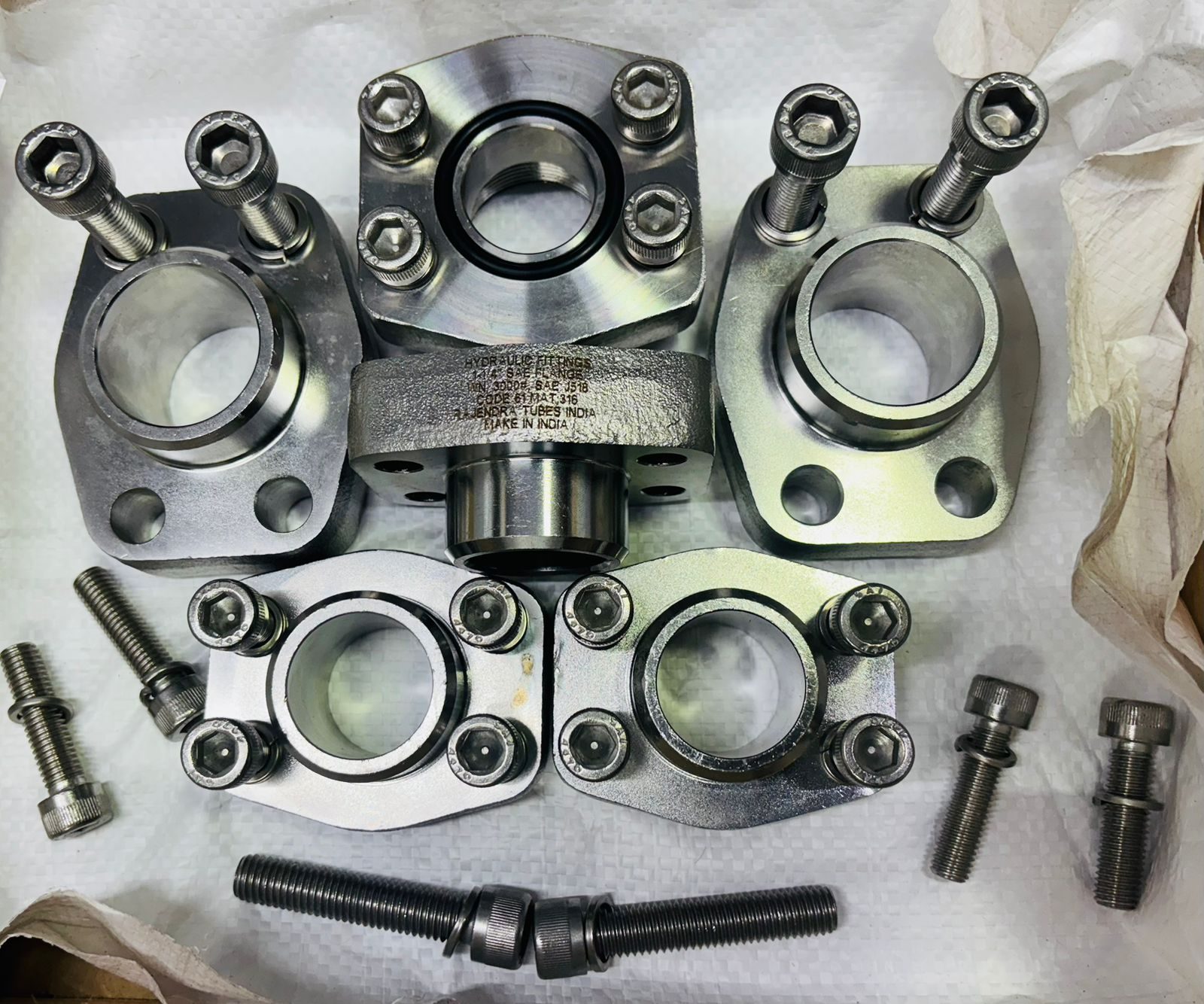
Code 61 (3000 psi) and Code 62 (6000 psi) four-bolt split flange connections with O-ring seal, for hydraulic power lines.
Flanges are rated by class — 150, 300, 600, 900, 1500, 2500 — not by a pressure. The class is a reference number; the actual allowable pressure depends on the material group and the temperature, and is read from the pressure-temperature tables in ASME B16.5. A Class 150 carbon steel flange is good for around 19.6 bar at ambient but only about 10 bar at 300 °C. Quoting “150#” as though it meant 150 psi at any temperature is a mistake that reaches site more often than it should.
Two flanges of the same class and NPS to B16.5 will always bolt together, regardless of type or material, because bolt circle, bolt count and bolt size are fixed by the standard.
Raised face (RF) is standard and concentrates the gasket load on a smaller area. Flat face (FF) is used against cast iron and other brittle equipment flanges, where a raised face would bend the flange and crack it. Ring type joint (RTJ) uses a metal ring in a machined groove and is used at high pressure and temperature.
The serrated finish on the face is not a defect — it is specified, normally 125–250 AARH, and it is what grips a soft gasket. A face machined too smooth can leak. Protect faces in transit and storage; a scored face is scrap.
Hydraulic power connections use a different system entirely: SAE J518 four-bolt split flanges, in Code 61 (3000 psi) and Code 62 (6000 psi). Sealing is by an O-ring in a groove in the flange head, not by a gasket between faces, and the two codes are not interchangeable — the bolt patterns and flange head dimensions differ. Our SAE flanges are stamped with the size, code and material, for example 1 1/4" SAE FLANGE 3000# SAE J518 CODE 61 MAT.316. Read the stamping rather than trusting the box.
Bolting is part of the joint, not an afterthought. The standard flange set is ASTM A193 B7 stud bolts with A194 2H nuts for carbon service, and A193 B8M with A194 8M for stainless. For low temperature use A320 L7. In sour service the bolting must meet NACE hardness limits too. Bolt circle, count and diameter for Class 150 and 300 are tabulated on our flange dimensions page.
Type, NPS, class, facing, grade and standard, and quantity. Add the gasket type if you want us to check compatibility, and specify NACE or low-temperature impact testing if either applies.
Request a quotation
Send the grade, size, schedule and quantity and we will come back with availability, lead time and price. No account, no sign-up.