Stud Bolts & Nuts
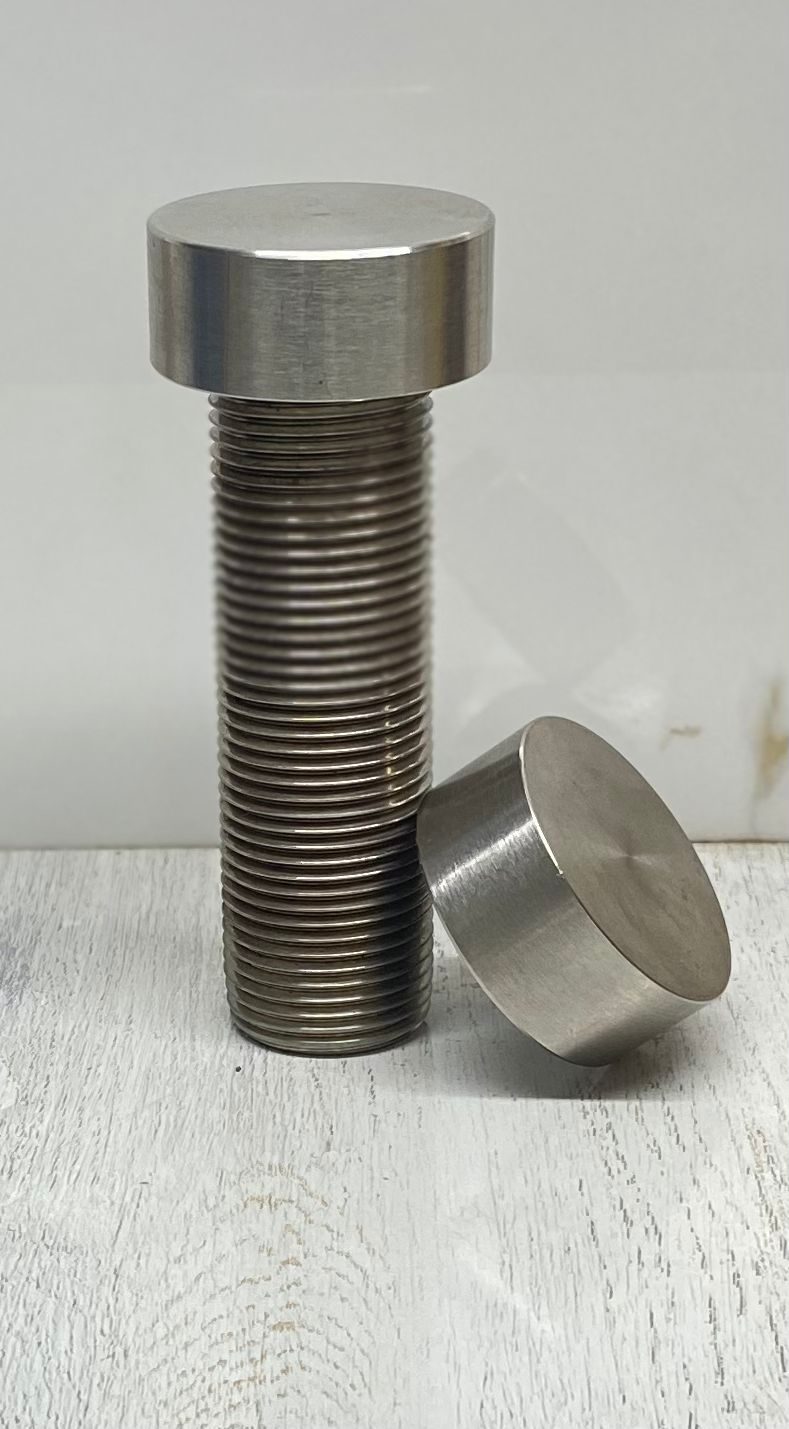
Fully threaded studs with two heavy hex nuts — the standard flange fastener set for ASME B16.5 joints.
| Types | Hex Bolt · Hex Head Screw · Stud Bolt · Threaded Rod · Hex Nut · Heavy Hex Nut · Washer · Socket Head Cap Screw · Foundation Bolt |
|---|---|
| Grades | Stainless A2-70 (304), A4-80 (316), ASTM A193 B8 / B8M, A194 Gr 8 / 8M · High tensile 8.8, 10.9, 12.9 · Alloy ASTM A193 B7 with A194 2H nuts · Duplex and nickel alloy on enquiry |
| Sizes | M3 to M64 · 1/4" to 2-1/2" · longer lengths and non-standard sizes to drawing |
| Threads | Metric coarse and fine · UNC · UNF · BSW · BSP |
| Standards | ASTM A193 · ASTM A194 · ASTM A320 (low temperature) · ISO 898-1 · DIN 931 / 933 / 934 · ASME B18.2.1 / B18.2.2 |
| Ends | Chamfered · Rolled thread (preferred for fatigue) · Cut thread |
| Finish | Self colour · Hot dip galvanised · Zinc plated · PTFE / Xylan coated · Passivated |
| Certification | MTC to EN 10204 3.1 · Hardness, tensile and impact reports on request |
Fully threaded studs with two heavy hex nuts — the standard flange fastener set for ASME B16.5 joints.
Partially or fully threaded hex head bolts in stainless and high-tensile grades.
High-strength allen-key fasteners, including the 3000# SAE J518 flange kits.
J-type, L-type and plate anchors for equipment and structural fixing.
High-tensile metric bolts are marked with two numbers, for example 8.8. The first is the tensile strength in hundreds of MPa; the second is ten times the ratio of yield to tensile strength. So an 8.8 bolt has a tensile strength of about 800 MPa and yields at about 80% of that — around 640 MPa. A 10.9 bolt is 1000 MPa tensile, yielding at 900. The marking is stamped on the head; if it is not there, you do not know what you have, and it should not go into a rated joint.
Stainless fasteners use a different system: A2-70 and A4-80. A2 is a 304-type steel and A4 is a 316-type with molybdenum; the second number is the tensile strength in tens of MPa. Note that stainless fasteners are substantially weaker than high-tensile steel — an A4-80 bolt is roughly equivalent to a grade 8.8 and is not a substitute for 10.9.
The standard set for a piping flange joint is a fully threaded stud bolt with two heavy hex nuts, not a hex bolt. The combinations you will see specified:
Bolt circle diameter, bolt count and bolt size are fixed by ASME B16.5 for the flange class and size; they are tabulated on our flange dimensions page. Stud length is chosen so that two to three threads protrude beyond each nut after tightening.
Stainless fasteners gall. The passive oxide film is what makes stainless corrosion resistant, and under the pressure and sliding of a tightening thread that film breaks down and the two surfaces cold-weld together. The nut seizes partway down and neither tightens nor comes off. Once it has happened, the fastener is destroyed.
Prevention is straightforward: use an anti-seize compound, tighten slowly, and avoid running nuts down with a power tool. Where galling is a persistent problem, Nitronic 60 has genuinely good anti-galling properties and is worth specifying for repeatedly disassembled joints.
A rolled thread is formed by displacing material rather than removing it, which leaves the grain flow following the thread profile and the root surface in compression. That gives substantially better fatigue performance than a cut thread, where the grain is severed. For dynamically loaded joints, specify rolled threads. All high-tensile bolts should have rolled threads as standard; on made-to-order studs it is worth stating.
Hot dip galvanising is the usual protection for carbon steel fasteners outdoors. The zinc layer adds thickness to the thread, so galvanised nuts are tapped oversize and must be used with galvanised bolts — mixing plain and galvanised parts causes seizing. PTFE and Xylan coatings provide corrosion protection with a controlled, consistent friction coefficient, which matters where the joint is torque-tightened to a specific preload.
Watch the galvanic pairing. A stainless fastener in an aluminium structure puts a large cathode against a small anode, and in a wet environment the aluminium will corrode around the fastener. Isolate the two, or choose a compatible material.
Type, size and length, thread form (metric coarse or fine, UNC, UNF, BSW), grade and standard, finish or coating, and quantity. For flange bolting, the flange NPS and class is enough — we will work out the size, count and stud length.
Request a quotation
Send the grade, size, schedule and quantity and we will come back with availability, lead time and price. No account, no sign-up.